

 (647) 478-5858
 (728) 500-4818
Accounting Firm · Content Hub + Topic Clusters (AEO)
Own the Questions Every Business Owner Asks
Owning the tax and bookkeeping questions clients search and ask AI
A small-business accounting firm had a handful of thin pages that ranked for its own name and nothing else, and it went missing whenever owners asked AI assistants about taxes or bookkeeping. We built a topic-cluster content hub, and the firm started showing up in search and in AI answers while owners were still figuring things out.
Results at a glance:
- Organic traffic up 175%
- Ranking for 320 new question keywords
- Consultation requests up 52%
- Cited in AI answers across tax topics

The Challenge
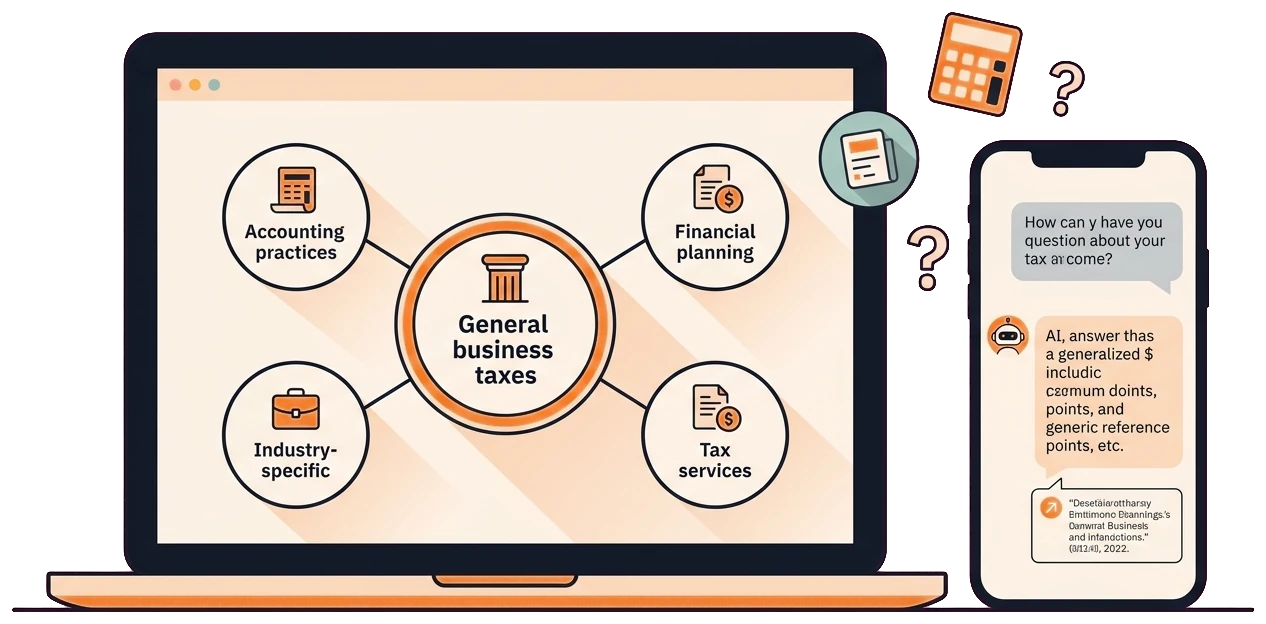
Business owners ask hundreds of questions before they hire an accountant. Things like how much should I set aside for taxes, or do I need to incorporate. The firm answered none of them online, so it never entered the conversation early and ended up competing on referrals alone.
When we looked under the hood, the reason was structural. There was no content architecture at all:
- No pillar pages to anchor any core topic
- No supporting cluster articles for the questions owners search
- No internal linking to connect related pages
- No answer-first writing, so nothing was quotable
- No FAQPage or Service schema, so AI engines had nothing to cite
- Neither Google nor AI saw the firm as an authority on anything
The Solution
We built a content hub organized into topic clusters around small-business tax, bookkeeping, and incorporation, so the firm could finally own the questions owners actually ask. It combined real SEO structure with answer-first writing built for AI. Here is what went into it.
- A strong pillar page for each core theme
- Supporting articles that link back to their pillar
- Topic clusters mapped to real questions
- Answer-first writing with FAQ and Service schema
- Question and keyword research to find real demand
- Internal linking that builds topical authority
- Content shaped so AI engines can lift and cite it
- AI-visibility tracking to see where the firm gets quoted
A cluster for every topic owners care about
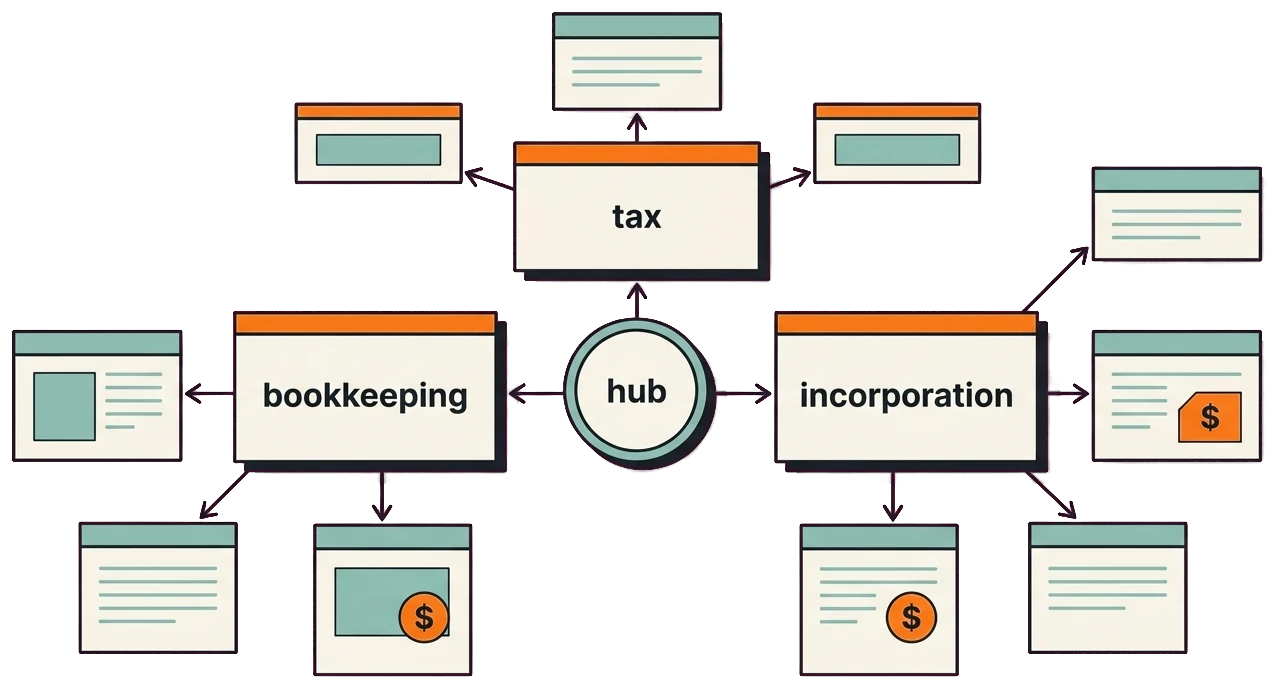
A pile of unconnected articles does not build authority. So we organized everything into clusters, each with a pillar page at the center and supporting articles feeding it. Google and readers both understand the structure at a glance.
- Three clear themes: tax, bookkeeping, and incorporation each got a dedicated pillar, so the firm reads as an authority on a whole topic, not a random page.
- Articles that feed the pillar: each supporting piece answers one specific question and links back, which is how the hub started ranking for 320 new question keywords.
- Internal linking with intent: related pages point to each other on purpose, so link equity and relevance flow to the pages that matter most.
- Mapped to avoid overlap: each article targets one question, so the firm’s own pages stop competing for the same search.
- Built to compound: as clusters fill in, authority grows across the whole theme, which is why traffic kept climbing over the months.
Written to be quoted by Google and AI
Ranking is not enough anymore. Owners increasingly ask ChatGPT and Google’s AI the same questions, so every piece opened with a concise, quotable answer and carried the right schema to be cited. That is the heart of good AI search optimization.
- Answer first, detail after: each page leads with a short, direct answer to the question in the title, which is exactly what an AI engine wants to lift into a reply.
- FAQPage and Service schema: structured data tells search and AI engines what the page is, so it became eligible to be cited in AI answers across tax topics.
- Written like an expert talks: clear, plain-language answers to real owner questions read as authoritative to both people and machines.
- Early in the buying journey: the firm now shows up while owners are still researching, so it enters the conversation long before a referral ever would.

How We Did It
01. Question research
Topic and question research in Semrush to find what owners actually search and ask AI about.
02. Cluster mapping
Mapped each theme into a pillar with supporting articles so the hub had a clear structure.
03. Build the pillars
Built strong pillar pages for tax, bookkeeping, and incorporation in WordPress.
04. Publish and structure
Published supporting articles with answer-first writing, FAQPage and Service schema, and internal linking.
05. Track AI visibility
AI-visibility tracking to see where the firm ranks and gets cited, then filled the gaps.
The Results
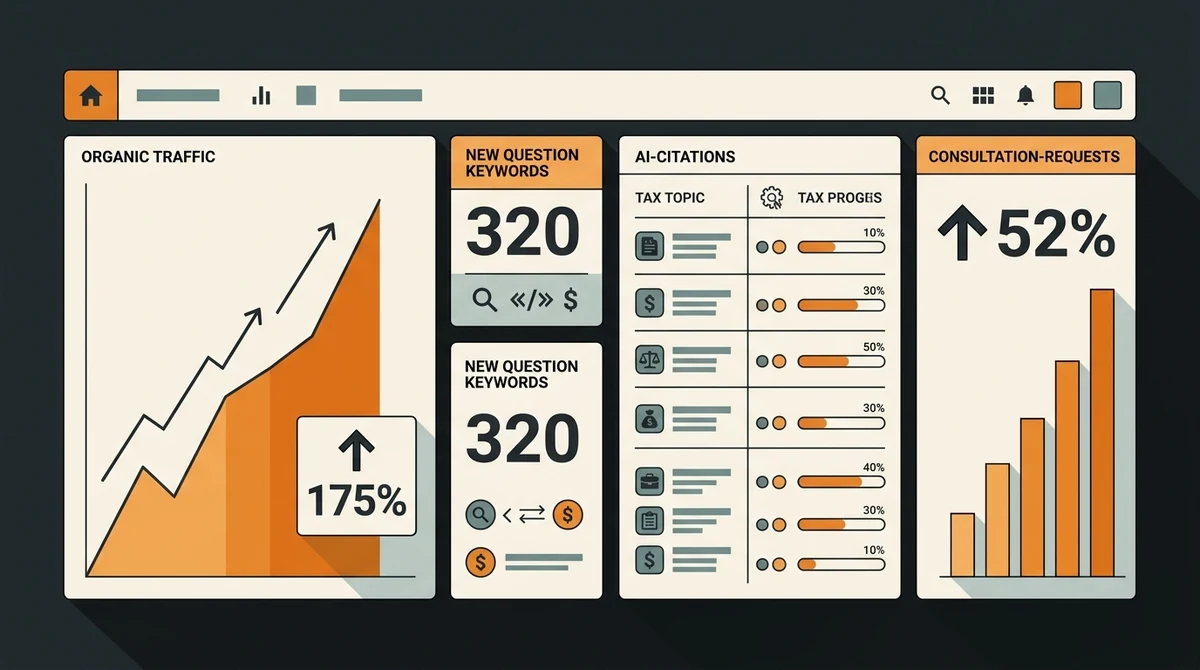
As the clusters filled in, the firm started ranking for the questions owners actually search and getting cited in AI answers for tax and bookkeeping topics. Organic traffic climbed 175%, the hub ranked for 320 new question keywords, and that early visibility fed a steady stream of qualified consultation requests, up 52%, instead of relying on referrals alone.
| Organic traffic | +175% |
| New question keywords | 320 |
| Consultation requests | +52% |
| AI answer citations | Across tax topics |
| Build time | 3 to 9 Months |
Services & tools used: Content strategy, topic cluster architecture, pillar and cluster content, FAQPage and Service schema, internal linking, Semrush, and WordPress.
seo“We used to wait for referrals. Now business owners find us on Google and through AI while they are still figuring out their taxes.“
Partner, Small-business accounting firm

Frequently Asked Questions
Invisible when owners search and ask AI?
We will map the topic clusters that let you own the questions your future clients are already asking. Show up in search and in AI answers while they research.
Get your free auditNo obligation. A 15-minute call and a clear action plan.
Services in this project: SEO · AI Search Optimization