

 (647) 478-5858
 (728) 500-4818
Commercial Appliance Repair · Google Ads / PPC Performance
Half the Cost, Twice the Right Leads
Cutting wasted spend and doubling qualified commercial leads
A commercial appliance repair company serving restaurants and facilities was running Google Ads that drained budget on the wrong searches. We rebuilt the account so it targeted commercial intent only, and cost per qualified lead dropped 48%.
Results at a glance:
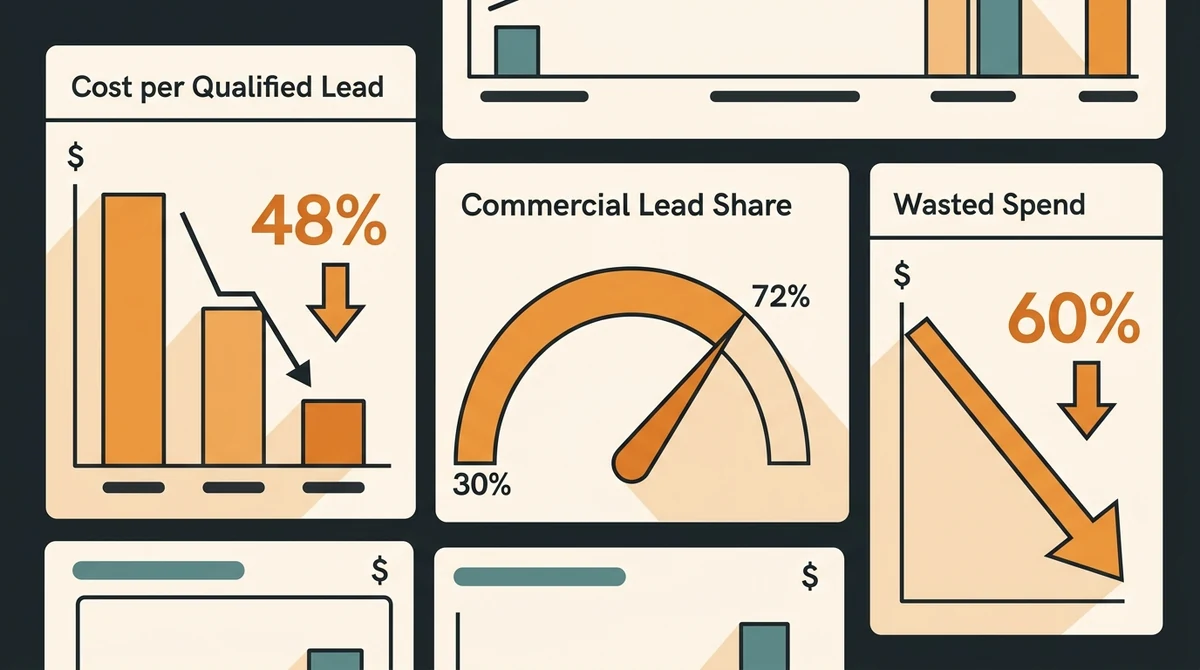
- Cost per qualified lead down 48%
- Commercial lead share up from 30% to 72%
- Wasted spend down 60%
- Restructured in 2 weeks

The Challenge
Spend was high, cost per lead kept climbing, and most of the calls were homeowners looking for a fridge fix, not the commercial accounts the business actually wanted. Every wrong call cost money and tied up staff who should have been quoting restaurants and facilities. The owner was ready to quit Google Ads entirely.
We audited the account, and it was clear where the budget was going. A handful of structural problems were bleeding it dry:
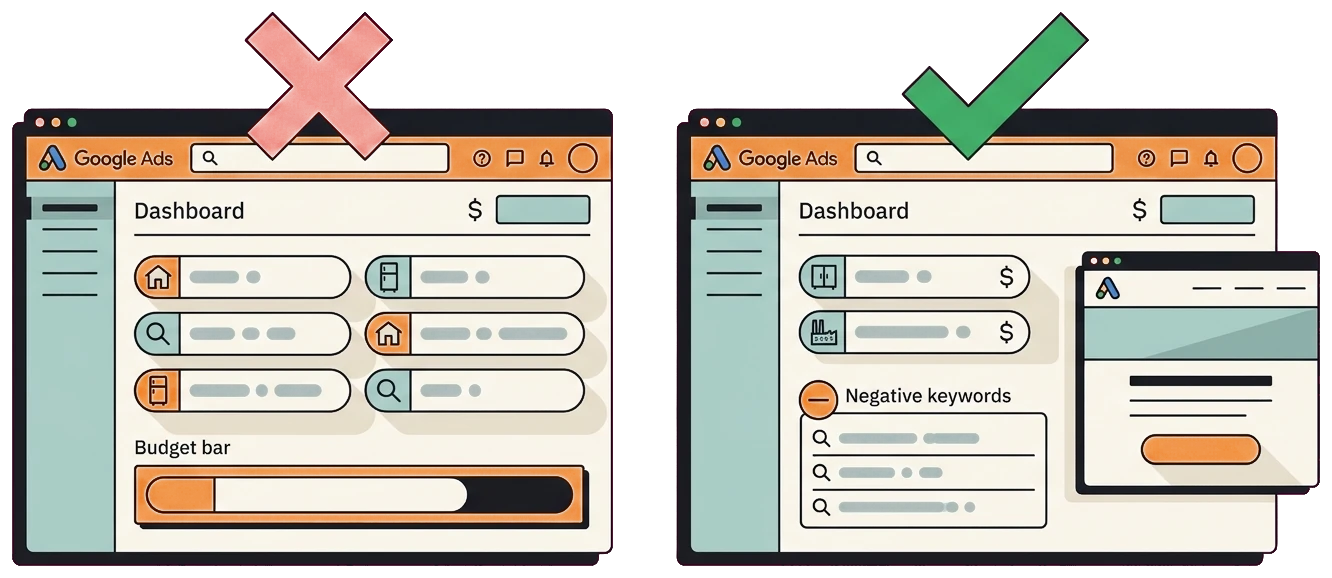
- Broad match keywords with almost no negative keyword list
- Residential and commercial intent mixed together in one campaign
- No conversion tracking on phone calls, so bidding was flying blind
- Ads pointed to the homepage instead of a commercial page
- Roughly half the budget was buying clicks from the wrong customers
The Solution
We rebuilt the account from the ground up so every dollar chased commercial work. Split intent, a deep negative keyword list, tighter match types, commercial-specific ad copy, a dedicated landing page, and proper conversion tracking so bidding could finally optimize on real leads. See the Google Ads work below.
- Split commercial and residential intent into separate campaigns
- Tightened match types to stop broad, irrelevant clicks
- A deep negative keyword list that blocks homeowner searches
- Call and form conversion tracking wired into bidding
- Commercial-specific ad copy that speaks to restaurants and facilities
- A dedicated commercial landing page instead of the homepage
- A bidding shift to maximize conversions on real leads
- A weekly search-term review to catch new waste early

The negative keyword list that stopped the bleeding
Most of the wasted spend came from one thing: broad match with no negatives, so the account paid for every homeowner searching to fix a fridge at home. We built a deep negative keyword list and kept adding to it every week.
- Block residential intent: terms like home, apartment and DIY were added as negatives so homeowner searches stopped triggering the ads.
- Tighter match types: we moved off loose broad match so the account only bid on genuinely commercial queries.
- Weekly search-term review: we reviewed actual queries for new mismatches and useful commercial language, adding negatives carefully so relevant long-tail searches stayed eligible.
- Budget goes to the right buyers: with the wrong clicks filtered out, the same budget reached far more restaurants and facilities, which is how wasted spend fell 60%.
Conversion tracking so bidding stops guessing
Most of these leads come in as phone calls, and the account was not tracking a single one. We set up call and form tracking through CallRail and Google Tag Manager so Google could finally bid toward real qualified leads.
- Call tracking: CallRail added source data to covered calls, while lead dispositions separated qualified commercial requests from residential, vendor, spam, and other calls.
- Form tracking: form submissions fire as conversions too, giving a complete picture of what each dollar produced.
- Smarter bidding: with real conversions feeding the account, the bidding strategy could optimize toward qualified leads instead of raw clicks.
- Clear attribution: the owner could finally see cost per qualified lead by campaign, so decisions were based on data, not gut feel.

How We Did It
01. Account audit
A full audit that found broad match, missing negatives and no call tracking draining the budget.
02. Conversion tracking setup
CallRail, GA4, and Google Tag Manager were connected so tracked calls and forms could be reviewed, qualified, and reported by source.
03. Campaign restructure
Split commercial and residential intent into separate campaigns with tighter match types.
04. Negatives and landing page
Built a deep negative keyword list and a dedicated commercial landing page for the ads.
05. Bidding and review
Shifted to maximize conversions and set up a weekly search-term review to keep waste out.
The Results
Cost per qualified lead fell by roughly half while the share of commercial inquiries rose sharply. The same monthly budget produced about twice the qualified commercial leads, because the spend stopped landing on homeowners and started reaching restaurants and facilities. The channel the owner nearly killed became the best one.
| Cost per qualified lead | -48% |
| Commercial lead share | 30% to 72% |
| Wasted spend | -60% |
| Build time | 2 Weeks |
Services & tools used: Google Ads, CallRail, GA4, Google Tag Manager, a dedicated landing page, and negative keyword research.
google adsThe account improved when qualification became measurable
Separating commercial intent from consumer repair traffic was only the first step. The more important change was connecting campaign decisions to qualified calls and leads instead of every recorded conversion.
- Search terms need regular human review, even when bidding is automated.
- Negative keywords should remove clear mismatches without blocking useful long-tail searches.
- Importing qualified outcomes gives bidding a better signal than lead volume alone.

Frequently Asked Questions
How we separated commercial leads from wasted clicks
Account evidence reviewed
We used search-term reports, spend and conversion records, call or lead outcomes, and the client's commercial-versus-residential qualification rules. That made it possible to measure cost per qualified commercial lead instead of relying on Google Ads' total conversion count.
Context for the paid-search result
The 48% lower qualified-lead cost, commercial lead-share change from 30% to 72%, and 60% reduction in wasted spend reflect this account's budget, geography, auction conditions, and reporting window. Future costs can move as competitors, demand, landing pages, and bidding conditions change.
Editorial review: Gilmedia strategy team. First published July 13, 2026.
Primary references
Related Gilmedia services
Paying for the wrong clicks?
We will show you exactly where your Google Ads budget is leaking and how to point it at the customers you actually want. Same spend, better leads.
Get your free auditNo obligation. A 15-minute call and a clear action plan.
Services in this project: Google Ads Management · Conversion Rate Optimization