

 (647) 478-5858
 (728) 500-4818
Two businesses publish the same answer to the same question. ChatGPT cites one. Perplexity recommends the other. Google AI Overviews ignores both and quotes a Reddit thread instead. Welcome to ranking in AI search in 2026.
There is no single trick to win AI citations. There are about 15 things that compound, and the businesses that do most of them outrank the businesses that do half of them. This is a tactical checklist, not a strategy framework. If you want the strategic version, read our Generative Engine Optimization playbook for 2026 first. Then come back here for the things to actually do this month.
The 15 tactics that move AI rankings in 2026
1. Build review velocity on Google plus at least two more platforms
AI engines cross-reference reviews across sources before deciding which business to recommend. A 4.8-star average on Google with nothing on Yelp, Apple Maps, or industry-specific sites makes the AI cautious. Aim for steady review velocity (4 to 8 new reviews per month) on Google, plus consistent presence on 2 to 3 secondary platforms relevant to your industry: Yelp, Trustpilot, G2 or Capterra (for SaaS), Houzz, Angi, Healthgrades, or Avvo.
2. Get mentioned in Reddit discussions in your niche
This is the underrated 2026 lever. Reddit is one of the most-cited sources inside Google AI Overviews and ChatGPT answers, especially for recommendation queries (“best X,” “anyone tried Y,” “what’s the difference between”). Identify the 3 to 5 subreddits where your buyers actually post questions, then participate genuinely. Answer questions, share insights, mention your business when it is relevant (and disclose your affiliation). Mods spot self-promotion fast, so the rule is: be a 95 percent contributor, 5 percent self-mentioner.
3. Earn reviews on third-party industry platforms
Beyond Google reviews, every industry has its own trusted platforms. Home services live on Houzz, Angi, and HomeAdvisor. Healthcare on Healthgrades, Zocdoc, RateMDs. Legal on Avvo and Justia. SaaS on G2 and Capterra. Restaurants on OpenTable and Resy. AI engines weight industry-specific review platforms because they signal that your business is recognized inside its category, not just generally.
4. Lead every page with a direct answer in 40 to 60 words
If your service page opens with “Welcome to our company, founded in 2007…” you have buried the answer. Open with the question someone would actually ask, then answer it in 40 to 60 words. AI engines lift these direct answers verbatim. Long brand intros guarantee that a competitor’s cleaner page gets cited instead.
5. Add FAQ schema to every key page
FAQ schema is the single highest-leverage technical add for AI citations. Each FAQ becomes a labeled snippet the AI can quote directly. Aim for 4 to 8 FAQs at the bottom of every service page and pillar post, with answers in the same 40 to 60 word range. For the full schema breakdown, see our schema markup for AI search guide.
6. Publish original case studies with named clients and real numbers
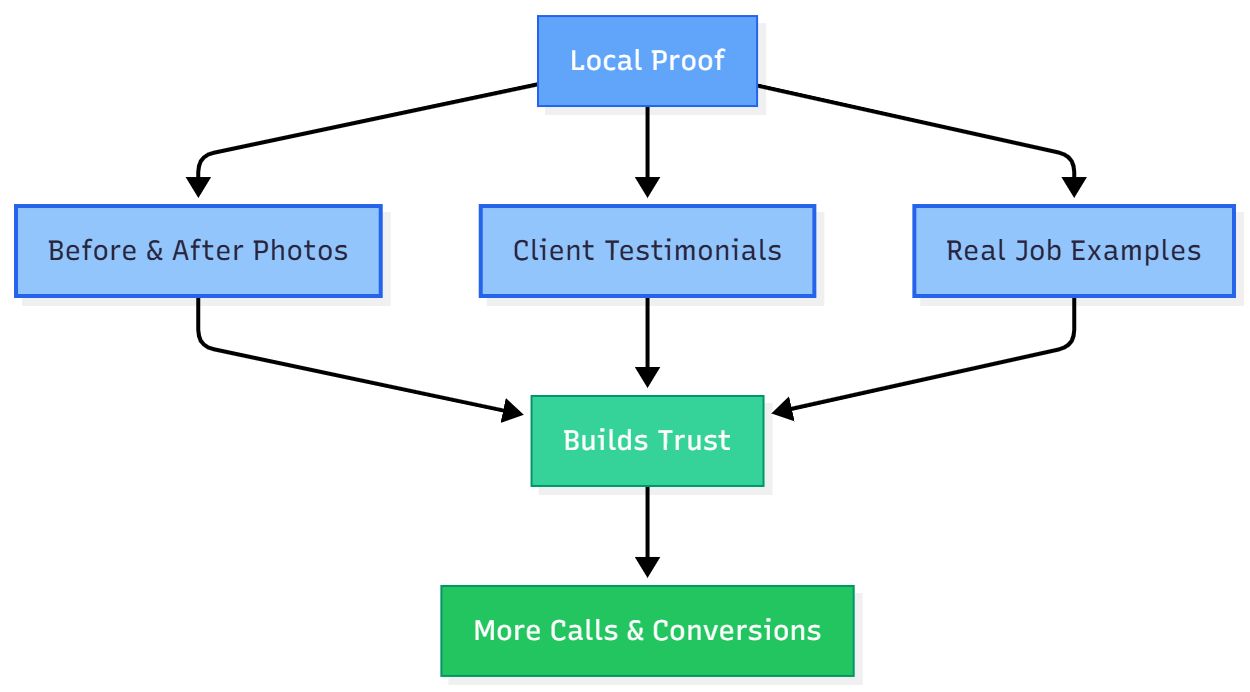
“We helped a Toronto roofing company go from 32 leads/month to 147 leads/month in six months” is the kind of content AI engines love because no other source can fabricate it. Real case studies, with real client names (with permission), real metrics, and real time frames build the kind of unique authority signals that earn citations across both AI engines and traditional search.
7. Create dedicated location pages with genuine local content
If you serve multiple cities, each city gets its own page with that city’s address, phone, team, photos, and local context. AI engines (especially for “near me” queries) lean heavily on these pages because they expose the geographic specificity that a generic “we serve the GTA” page cannot. For the full multi-location framework, see our multi-location SEO guide.
8. Build entity signals via Wikipedia, Wikidata, Crunchbase, and LinkedIn
AI engines verify a business is a distinct, real entity by checking the structured data ecosystem: Wikipedia entries (where notable), Wikidata records, Crunchbase profiles, LinkedIn Company pages, and verified social profiles. You may not qualify for a Wikipedia article, but Wikidata, Crunchbase, and LinkedIn are within reach for almost every legitimate business. The more of these “entity anchors” you have, the more confidently AI engines cite you.
9. Get listed on credible industry directories
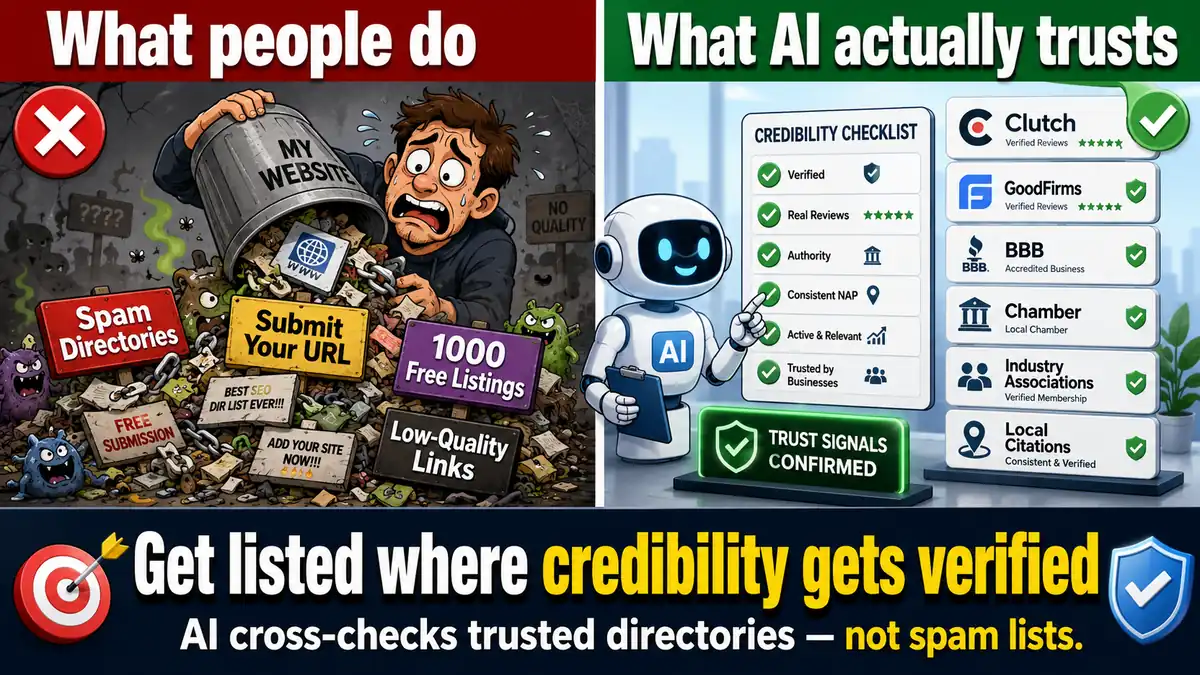
Not all directories are equal. Skip the spam directories and the “submit your URL” sites. Focus on industry-recognized directories that AI engines actually crawl: Clutch and GoodFirms for agencies, AAA for travel, BBB and chamber sites for local, industry associations for specialists. These are the directories the AI cross-checks against when verifying that you are a real, credible business in your space. The foundational version of this is in our local citations and NAP consistency guide.
10. Earn quote-based press mentions through digital PR
Sign up for Connectively (formerly HARO), Qwoted, and SourceBottle. Watch for queries from journalists in your industry or market. Respond with a tight 100-word quote and your bio. Even one quoted mention per quarter from a real publication is more valuable for AI citation rates than a dozen guest posts on low-quality sites. AI engines lean on news and journalism as trusted sources, so getting cited there carries weight.
11. Publish original data or research, even small samples
“The 5 most common plumbing failures in Toronto basements in winter, based on 380 service calls” is the kind of content AI engines love because no other source can offer it. You do not need a 10,000-respondent survey. A small, real, internally-sourced data set, packaged into a useful article, earns citations because there is no alternative source to fall back on.
12. Allow AI crawlers in your robots.txt
Check your robots.txt right now. The bots that matter in 2026: GPTBot (OpenAI), ClaudeBot (Anthropic), PerplexityBot, Google-Extended (Google AI training and serving), Applebot-Extended (Apple Intelligence), Bingbot, and CCBot (Common Crawl, which feeds many engines). Some SEO plugins added blocks by default. Audit and allow the engines whose surfaces you actually want to appear in.
13. Get included in “best of” and roundup listicles on authoritative sites
AI engines love to quote roundups. “10 best CRMs for small business” or “Top plumbers in Toronto” articles get cited disproportionately because they consolidate recommendations the AI can paraphrase. Find the existing roundups for your category, pitch the editors with a tight value proposition and proof, and aim to be added on the next refresh. One inclusion in a high-authority roundup beats 20 generic blog mentions.
14. Use question-format headings that mirror real voice and AI queries
“What is the difference between AEO and GEO?” is a heading. “AEO vs GEO” is a label. Both work for traditional SEO, but the heading wins for AI search because it matches the exact phrasing a user types into ChatGPT. Restructure your H2 and H3 tags to be the questions, not the topics. The shift takes minutes per page and consistently lifts citation rates.
15. Maintain consistent NAP, branding, and entity signals across the web
Your business name, address, phone, logo, and brand description should match across Google Business Profile, Apple Business Connect, LinkedIn, Crunchbase, your website, all directories, all social profiles, and every press mention. Inconsistencies fragment your entity signal. AI engines treat fragmented entities as low-confidence and skip them. Run an annual audit. The foundational checklist is in our NAP consistency guide.
What this looks like in practice
You will not implement all 15 in a week. The smart sequence:
- Week 1: Tips 4, 5, 12, 14 (on-page direct answers, FAQ schema, robots.txt audit, question-format headings). These are mostly editing your own site.
- Week 2-4: Tips 1, 3, 9, 15 (review velocity setup, third-party reviews, credible directories, NAP audit). Off-site reputation foundation.
- Month 2: Tips 6, 7, 8 (case studies, location pages, entity anchors). Content and credibility build.
- Month 3+: Tips 2, 10, 11, 13 (Reddit participation, digital PR, original research, roundup pitches). The slower, compounding outreach work.
Track results with a real AI visibility setup, not just rankings.
Common mistakes when chasing AI rankings
- Treating AI SEO as a separate channel. It is a layer on top of traditional SEO. If your technical fundamentals are broken, no amount of AI-specific tactics will save you.
- Spamming Reddit. The fastest way to get banned and have your business name flagged as spam across the AI ecosystem. Participate genuinely or not at all.
- Buying fake reviews. AI engines detect review velocity patterns and authenticity. A sudden spike of 50 5-star reviews from new accounts gets flagged and devalued.
- Stuffing schema everywhere. Add only the schema types that match the actual page content. Misuse triggers penalties.
- Forgetting measurement. Without an AI visibility tracking setup, you have no idea what is working. Guesswork is not strategy.
Frequently asked questions about ranking in AI search
How long until I start getting cited by AI engines?
Most businesses see citation lifts within 60 to 120 days after implementing the on-page tactics (4, 5, 14) and the core off-site work (1, 3, 9). The slower-compounding tactics (Reddit, PR, research) pay off over 6 to 12 months. AI engines also update their training and live retrieval cycles on different cadences, so expect uneven gains by engine.
Does Reddit really help with AI rankings?
Yes, more than most SEOs admit. Google AI Overviews now cite Reddit threads for many recommendation queries, and ChatGPT pulls from Reddit content via Bing’s index. Participating genuinely in your niche subreddits gets your business mentioned in the threads AI engines are already citing.
Do I need to be on every AI engine?
Focus on the engines your buyers actually use. For most B2C and local businesses in 2026, that means Google AI Overviews first, then ChatGPT and Perplexity. For B2B, ChatGPT and Perplexity carry more weight. Check your analytics referrers to see where AI traffic is already coming from.
Are paid AI SEO services worth it?
If they execute the tactics on this list, yes. If they promise rankings without explaining how, no. The category is full of agencies repackaging traditional SEO with an “AI” label. Ask any prospective agency to show you their schema implementations, case study content, and AI tracking setup before you sign.
Will AI search replace traditional SEO?
No, it sits on top of it. AI engines crawl, index, and weigh signals the same way classic search does, then add their own retrieval and synthesis layer. Strong traditional SEO is the floor. AI optimization is the ceiling. Both matter.
Get a complete AI search audit
Most sites we audit are doing 4 to 6 of the 15 tactics on this list. The gap is where the rankings live. Our AI SEO service implements the full stack: schema, content restructuring, citation work, Reddit and digital PR strategy, AI visibility tracking, and ongoing optimization. Contact us for a quote.