

 (647) 478-5858
 (728) 500-4818
Most local businesses give up on link building before they start. The advice they read online is for SaaS companies and B2B blogs: write guest posts, build a HARO routine, run digital PR campaigns. None of that fits a plumber, a dentist, or a roofing company. So most local sites end up with backlinks from their three industry directories, their accountant’s website, and nothing else.
The truth is that local link building in 2026 is one of the highest-leverage activities a local business can do, because almost none of the competition is doing it well. Eleven tactics below still work in 2026, and most of them cost less than a single Google Ads click.
Why local links still move local rankings
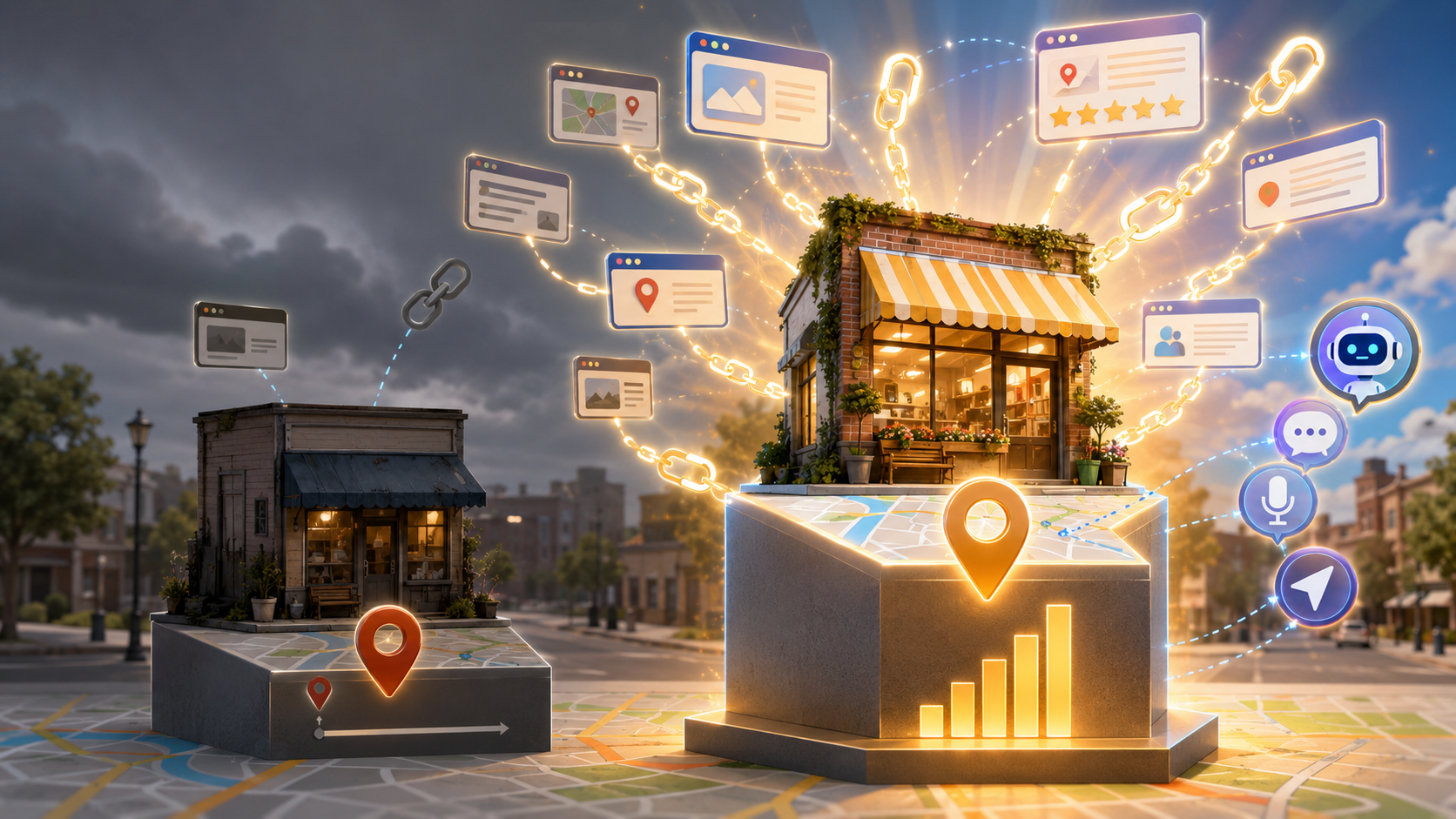
Local search is a popularity contest measured in three ways: relevance (does Google know what you do), proximity (are you near the searcher), and authority (does the open web vouch for you). Authority is where backlinks live. In 2026, the picture got more complex because AI engines also use the same link graph to decide which businesses to cite.
- Local pack rankings. Google’s local algorithm still weighs prominence (mostly link and review signals) alongside relevance and proximity.
- AI Overviews and chat answers. Generative engines cross-reference link-cited businesses against unlinked ones, often siding with the one the open web confirms.
- Domain authority halo. Even links that do not directly drive traffic build the site-wide authority that lets every page rank slightly higher.
Link building is one of the slower-paying levers in local SEO, but its returns compound for years. The local SEO programs we run inside our SEO services always include a local link plan because the foundational layers (GBP, citations) eventually hit a ceiling without it.
The 11 local link building tactics that still work in 2026
1. Sponsor a local event, team, or non-profit
Almost every local non-profit, youth sports team, charity run, or community event publishes a sponsors page. A $250 sponsorship often gets you a logo placement plus a dofollow backlink from a legitimately local page Google trusts. Pick causes that align with your customers. The community goodwill is real and the link is a bonus.
2. Get listed on local “best of” and roundup pages
Search “[your city] best [your service]” and find the listicle and roundup posts. Many are run by local bloggers, news sites, or chamber publications that update their lists. Reach out with a short pitch, your differentiators, and a recent example of your work. Half will ignore you, a quarter will reply, and the ones that say yes give you a link from a page that already ranks for your money keyword.
3. Build relationships with local journalists
Local newspapers and TV stations still publish daily online. They need quotes from local experts. Sign up for HARO (now Connectively), Qwoted, and SourceBottle and watch for queries from your local market. When relevant, respond with a 100-word quote and a clear bio. Even one local news mention per quarter compounds into a serious link portfolio over two years.
4. Pitch a guest column to your local outlets
The flip of the journalist relationship: become a regular contributor. Local business journals, lifestyle magazines, and community blogs are often eager for “ask the expert” columns from established local pros. One monthly column on a respected local site gives you 12 backlinks per year from authority pages.
5. Join (and contribute to) your local chamber and BIA
Your local Chamber of Commerce and Business Improvement Area (BIA) websites both publish member directories with backlinks. The links are usually nofollow, but Google still treats high-authority local directory mentions as relevance signals. Beyond the link, chamber events build the relationships that produce the bigger link wins on this list.
6. Trade backlinks with non-competing local businesses
The plumber, the electrician, and the HVAC contractor are not competitors. Each one knows their customers eventually need the other two. A simple “trusted local partners” page on each of your sites, with mutual links, creates a small but authoritative local link circle. Done modestly (3 to 5 partners), this looks natural to Google and helps everyone involved.
7. Publish original local data or research
“Average HVAC repair cost in Toronto in 2026” or “Most common plumbing issues in Florida homes.” Pull internal data, even from a small sample, package it as a stat-driven article, and pitch it to local journalists and trade publications. Original data is one of the few content formats that consistently earns links unprompted because there is no other source to cite.
8. Speak at local events and meetups
Local industry meetups, trade shows, and conferences all publish speaker lists with backlinks. Pitch yourself as a speaker on a topic where you have real expertise (your local market, your craft, your industry trends). Even a 15-minute lightning talk gets you on a speaker page and into the post-event recap that the organizer publishes.
9. Build a scholarship for a local school or program
Scholarships from local businesses to local schools, community colleges, and trade programs are often listed on .edu and .org pages with high domain authority. A modest $500 to $1,000 annual scholarship plus a one-page application creates an .edu-linked relationship that pays dividends for years. The tactic was abused in the late 2010s, so keep it genuinely local and genuinely funded.
10. Get reviewed by local bloggers and YouTubers
Most cities have a handful of local lifestyle YouTubers, food bloggers, or “things to do in [city]” creators. Offer a free product, service, or experience in exchange for a review (disclose properly). You will get a link, often a video embed, and the kind of authentic third-party validation AI engines now weight heavily when deciding who to cite.
11. Reclaim and fix unlinked brand mentions
Your business name is probably mentioned across the web in articles, forums, and directories without a link back to your site. Use Ahrefs Content Explorer, Google search (“Your Business Name” -site:yoursite.com), or Brand24 to find them. Email the site owner with a polite note: “Thanks for the mention, would you mind linking to our site?” Conversion rate is 15 to 30 percent, and the links are exactly the kind Google trusts.
What to avoid in local link building
- Paid link networks. The “buy 50 backlinks for $99” services use the same footprint Google has been suppressing since 2012. The risk is now devaluation rather than penalty, but the value is zero either way.
- Mass guest post outreach. Generic guest post pitches to 500 sites at once produce mostly low-quality placements on sites that exist only for guest posts. Skip.
- Excessive exact-match anchor text. A profile dominated by “plumber Toronto” anchors looks engineered. Mix branded, URL, partial-match, and natural phrasing.
- Linking schemes disguised as partnerships. A “trusted partners” page with 30 mutual links to obviously unrelated businesses is a red flag. Keep it small, relevant, and real.
- PBNs (private blog networks). Still actively penalized in 2026. Anyone selling these to local businesses is selling them a future de-indexing.
How to measure local link building success
- New referring domains per quarter. Quality matters, but a steady increase in unique referring domains (not just total links) is the cleanest progress signal.
- Local-relevance share. What percentage of your links come from sites in your city or industry? The higher, the better for local rankings.
- Anchor text diversity. A healthy profile has a wide spread, not 80 percent of links pointing with the same keyword.
- Local pack movement. Track your top 10 commercial keywords’ local pack positions monthly. Link building’s effect shows up here on a 3 to 6 month lag.
- AI citation lift. If you are tracking AI search visibility (see our AI visibility tracking guide), watch whether citation rate rises in parallel with referring domain growth.
Frequently asked questions about local link building
How many links does a local business need to rank?
It depends on competition. For low-competition local niches, 20 to 50 relevant referring domains can be enough. For dense markets (Toronto plumbers, Miami real estate), expect to need 100 to 300 quality referring domains to compete with top-of-pack businesses.
Are nofollow links still worth pursuing?
Yes. Google explicitly treats nofollow as a hint, not a directive, since 2019. Nofollow links from authoritative local sites still contribute to entity signal and AI citation confidence. Do not chase them, but do not turn them down either.
How long until link building shows in rankings?
3 to 6 months for early movement, 12 to 18 months for the compounding effect to become obvious. Local link building is slow, which is precisely why so few competitors do it consistently, which is precisely why it works.
Should I hire a link building agency?
Be cautious. The cheap end of the industry produces low-quality, low-effort placements that often do more harm than good. Look for an agency that focuses on real outreach to real local sites, can show actual examples of placements, and prices accordingly ($150 to $500 per link is the honest market range in 2026).
Do directory citations count as backlinks?
Some do, most do not in any meaningful way. Most directory citations are nofollow or do not link at all. They help local entity confidence, which is valuable, but they are not a substitute for real editorial links from local publications, partners, and community sites.
Need help building your local link portfolio?
Local link building is the longest-paying lever in local SEO, which is also why most agencies skip it. Our SEO services include an outreach-driven local link program tailored to your city and industry, paired with full GBP optimization and citation cleanup. Contact us for a quote.