

 (647) 478-5858
 (728) 500-4818
Two businesses publish the same answer to the same question. ChatGPT cites one and ignores the other. The page that wins almost always has cleaner schema markup. Not better writing, not more backlinks, just better structured data the AI can actually read.
Schema markup is the underrated lever in AI search. Google has rewarded it since 2015. AI engines like ChatGPT, Perplexity, Gemini, and Copilot now lean on it even harder because it gives them labeled, machine-extractable facts instead of free-form HTML. This guide breaks down the 7 schema types that actually move the needle for AI citations in 2026, in the order you should add them.
What is schema markup, and why does it matter for AI?
Schema markup is structured code (usually JSON-LD) that you add to a web page to tell search engines and AI systems exactly what the page is about. Instead of making the AI guess that “Acme Plumbing” is a business with a phone number and a service area, you label it.
For traditional SEO, schema unlocks rich snippets: star ratings, FAQ accordions, recipe cards, and event listings inside search results. For AI search, schema does something more valuable. It gives the language model clean, pre-parsed facts to lift into a generated answer. The AI no longer has to read your prose and hope it understands. The schema hands it the answer on a labeled tray.
If you want the full strategy that surrounds this, see our SEO for AI service page, which covers schema as part of a broader Answer Engine Optimization and Generative Engine Optimization workflow.
Why AI engines weight schema heavily
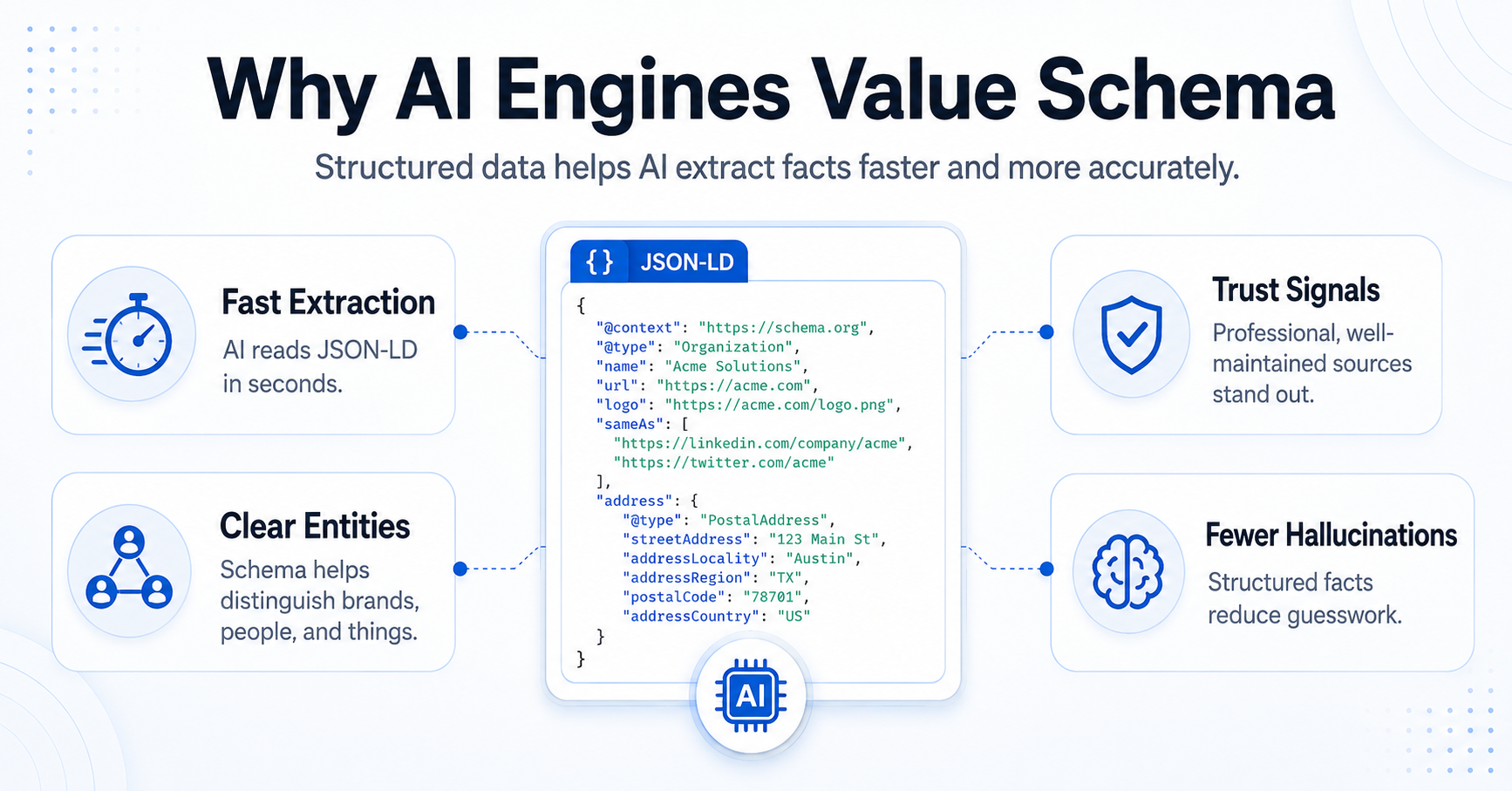
- Extractability: A model can pull a fact from JSON-LD in milliseconds. Parsing free text is slower and more error-prone.
- Trust signals: Schema is a sign the publisher cares about accuracy. AI engines favor sources that look professionally maintained.
- Entity disambiguation: “Apple” the company versus “apple” the fruit gets settled by Organization schema with a clear @id and sameAs links.
- Fewer hallucinations: AI engines are tuned to avoid making up answers when they can quote a structured source. Schema is the structured source.
The 7 schema markup types that get you cited
1. Organization schema (the foundation)
Every site needs Organization schema on the homepage, and ideally referenced across every page. It tells AI engines who you are, where you are, your logo, your social profiles, and what entities you are associated with. Without it, the AI does not know your brand is a distinct entity, so it cannot cite you confidently.
Minimum fields to include: name, url, logo, contactPoint, sameAs (linking to your verified social profiles, Wikipedia if applicable, Crunchbase, etc). Skip this and every other schema type loses half its value.
2. Article and BlogPosting schema
For every blog post, news article, or content page, add Article or BlogPosting schema with: headline, description, image, author, publisher, datePublished, and dateModified. This is the schema AI engines use to decide which version of a topic is the most authoritative and current.
The dateModified field is especially important. AI engines prefer fresh content for time-sensitive topics, and they read this date directly from your schema. Update old posts and bump the modified date when you do, otherwise the AI assumes your 2022 article is still 2022.
3. FAQPage schema (the citation magnet)
FAQ schema is the single highest-leverage type for AI citations in 2026. When you wrap a question and answer in FAQPage schema, you are handing the AI a citation-ready snippet. The model can lift the answer verbatim, attribute it to your site, and link back.
Best practice: add 4 to 8 FAQs at the bottom of every service page and pillar post. Keep answers between 40 and 80 words, written as a complete, standalone response. If the answer cannot stand alone outside the page, the AI will not use it.
4. HowTo schema (step-by-step extraction)
If your content teaches a process, add HowTo schema with itemListElement for each step. AI engines love step-by-step content because it answers procedural queries cleanly. “How do I unclog a drain” or “How do I cancel my subscription” pulls directly from HowTo-marked pages more often than from prose tutorials.
Add image, name, and text fields to each step. The richer the data, the more likely the model will quote your version over a competitor’s.
5. Product and Offer schema
For eCommerce or SaaS, Product schema with Offer details (price, availability, currency, sku) is non-negotiable. AI shopping assistants and chat-based product recommendations rely on this data to surface your inventory inside their answers.
Add AggregateRating and Review schema where you have legitimate reviews. AI engines now weight third-party validation heavily, and they will not cite a product that has no review signals when a competitor’s does.
6. LocalBusiness schema (for local citations)
If you serve a specific geography, LocalBusiness schema is how you get cited for “near me” queries inside AI answers. Fill in name, address (full PostalAddress block), telephone, geo (latitude and longitude), openingHoursSpecification, and areaServed.
Pair it with a verified Google Business Profile, consistent NAP across directories, and real customer reviews. Our Google Business Profile optimization service covers the off-site half of this stack.
7. Person and Speakable schema (the underused pair)
Person schema, attached to your authors via the author field of Article schema, signals expertise. AI engines now factor author identity into citation decisions, especially for YMYL topics (medical, legal, financial). Include knowsAbout, sameAs links to LinkedIn and verified profiles, and a real bio.
Speakable schema marks the parts of your page that voice assistants and AI voice answers should read aloud. It is still small in volume but growing fast as more queries shift to voice-driven AI. Adding it now is a quiet edge over competitors who have not noticed it yet.
How to test your schema (and catch silent failures)
Adding schema is half the job. Validating it is the other half. Three tools to run after every change:
- Google Rich Results Test: Confirms Google can parse your markup and shows what rich features it qualifies for.
- Schema.org Validator: The neutral validator. Catches structural errors even if Google ignores them.
- Search Console schema reports: Surfaces real-world issues after the page is indexed, including markup that worked in testing but broke in production.
Silent failures are the killer. Schema can validate but still be ignored by AI engines if the data is thin, contradicts the page content, or duplicates another schema block. Always cross-check that your schema agrees with what is visibly on the page.
Common schema mistakes that kill AI citations
- Schema that contradicts the page. If your Product schema says $99 but the visible price is $129, AI engines drop the citation and may demote the page.
- FAQ schema with answers that are not actually on the page. Google has explicitly downranked this. Always show the FAQ visibly to users.
- Stuffing every page with every type. Use the schema that fits the page. A blog post does not need Product schema.
- Missing @id and sameAs. Without unique identifiers, AI engines cannot connect your schema to your broader entity footprint.
- Schema placed in the wrong field. WordPress sites should add JSON-LD via a dedicated plugin field, not pasted into the post body. Our preference is to centralize it in the SEO plugin so it survives editor saves.
Where schema fits in your overall AI search strategy
Schema is one layer of the stack. It sits between your written content and the AI engines that need to extract it. Without it, even the best-written page is harder to cite. With it, even moderately written content can outperform competitors because the AI can lift your answer cleanly.
If you are building this from scratch, the order is: 1) fix technical SEO and crawlability, 2) add the schema types above, 3) restructure content for extraction, 4) earn third-party mentions, 5) track AI citations. The full sequence is in our Generative Engine Optimization playbook for 2026. For context on how all of this differs from classic search, see AEO vs SEO.
Frequently asked questions about schema for AI
Does schema markup actually help with AI search rankings?
Yes. Schema does not directly rank a page, but it dramatically increases citation rate inside AI-generated answers. Pages with FAQ, Article, and Organization schema get cited measurably more often than equivalent pages without them.
Which schema type should I add first?
Start with Organization schema sitewide, then add Article schema to every blog and content page, then layer FAQ schema on service pages and key posts. Those three cover 80 percent of the citation opportunity.
Is JSON-LD better than microdata or RDFa?
Yes. JSON-LD is the format Google and most AI engines prefer because it lives in a single script block and does not entangle with HTML. Microdata still works, but JSON-LD is cleaner to maintain and easier for automated tools to parse.
Can I have too much schema on one page?
Yes. Stacking irrelevant or duplicated schema confuses parsers and can trigger Google penalties. Add only the types that match the page’s actual content, and combine them into a single @graph block when possible.
Does schema get my page cited by ChatGPT specifically?
Indirectly. ChatGPT uses Bing’s index and web retrieval, and Bing reads schema. Schema also helps Perplexity, Google AI Overviews, and Copilot, which crawl your site directly. Adding schema lifts citation rate across all of them, not just one engine.
Get your schema audited and implemented
Most sites we audit have either no schema, broken schema, or schema that contradicts the visible content. Fixing it is one of the fastest wins in AI search. If you want a professional audit and implementation, our SEO services include full schema setup as part of every engagement, and our AI SEO program ties it into the broader citation strategy. Contact us for a quote.