

 (647) 478-5858
 (728) 500-4818
Your ranking report says position 4 for your money keyword. Traffic is flat. Leads are flat. Something is missing, and your tracker cannot see it: ChatGPT mentioned a competitor in 38 percent of buyer-intent queries last month, Perplexity is recommending a different brand entirely, and Google AI Overviews are quoting a third party above your link. None of that shows up in a traditional rank tracker.
AI search visibility is now its own measurement category. If you are investing in AI SEO and Answer Engine Optimization, you need a way to know whether it is working. This guide walks through what to track, the free methods that work today, and the paid tools worth a look in 2026.
Why traditional rank trackers miss AI citations
Classic SEO tools measure one thing well: where your URL sits in a blue-link search results page. AI search broke that model in three ways.
- The interface changed. ChatGPT and Perplexity return paragraph answers, not lists of links. There is no “position 1” to track.
- Citations are non-deterministic. Ask the same question twice and a different brand may get cited. You need sampling, not a single check.
- Queries are conversational. Users type sentences, not short keywords. Your tracker watches “best plumber Toronto,” but real users are asking “who should I hire to fix a slab leak in North York.”
Until your measurement catches up to where buyers actually are, you are flying blind on the surfaces that drive new business.
The 4 KPIs that matter for AI search visibility
1. Citation rate
For a set of priority queries, how often does an AI engine cite your brand or link to your site in its answer? Expressed as a percentage across a sample of queries. A 10 percent citation rate on a 100-query set means you got mentioned in 10 answers. This is the closest equivalent to “ranking” inside generative search.
2. Share of voice
Of all the brand mentions on a given query, what percentage are yours? If ChatGPT names three plumbers in response to “best plumber in Toronto” and you are one of them, your share of voice on that query is 33 percent. Tracked over time, this metric shows whether you are gaining or losing ground against named competitors.
3. Sentiment and context
Getting mentioned is good. Getting mentioned positively, in the right context, is better. Track how the AI describes you: as a top choice, a budget option, a niche specialist, or simply as one of many. If the framing is wrong, the citation does not convert.
4. Referral traffic from AI surfaces
When an AI engine links to your site, the click usually arrives with a recognizable referrer (chat.openai.com, perplexity.ai, gemini.google.com, copilot.microsoft.com). Filter your analytics by these sources to measure what AI citations actually send you. Volume is still small for most businesses, but quality is high. These visitors arrive with intent.
Free methods that work today
Manual prompt sampling
Build a list of 20 to 50 priority queries that real customers would ask. Once a week, run the same queries through ChatGPT, Perplexity, Gemini, and Copilot. Record whether your brand was cited, how it was described, and which competitors showed up. A simple spreadsheet works. Consistency matters more than fancy tooling.
Google Search Console for AI Overviews
Google has started surfacing AI Overview appearances in Search Console performance reports. Filter by “Search Appearance” and watch for AI Overview impressions and clicks. The data is still incomplete, but it is the only first-party signal Google offers, and it is free.
Brand mention searches
Set Google Alerts for your brand name plus AI-context keywords (“[your brand] best,” “[your brand] vs,” “[your brand] review”). When AI engines surface answers about you, the underlying source pages often show up in the alert.
Referrer filtering in Google Analytics
Add chat.openai.com, perplexity.ai, gemini.google.com, copilot.microsoft.com, and you.com as filtered sources in your analytics dashboard. The volume will start small. Track the trend, not the absolute number.
Paid tools to know in 2026
A new category of AI visibility tools launched between late 2024 and early 2026. They automate the sampling, scoring, and reporting that manual methods do by hand. The right pick depends on your scale and budget.
- Profound: Tracks brand mentions and competitive share of voice across major AI engines, with prompt-level breakdowns.
- Otterly: Monitors how AI assistants answer about your brand and competitors, with sentiment analysis baked in.
- AthenaHQ: Focuses on enterprise GEO tracking with dashboards for citation rate, share of voice, and prompt visibility.
- Peec AI: Tracks visibility across ChatGPT, Perplexity, Gemini, and Claude, with alerts for drops.
- Brandlight: Combines AI mention tracking with workflow tools for content teams to act on the data.
- Semrush AI Toolkit: Adds AI visibility tracking to an existing Semrush subscription, useful if you already pay for traditional rank tracking.
- Ahrefs Brand Radar: Tracks brand mentions across the web, including AI-cited pages, with backlink-style discovery.
Most of these tools price between $99 and $499 per month for small to mid-market teams. Enterprise plans run higher. None of them are perfect yet, and the category is changing fast. Pick the one that fits your stack and re-evaluate in 6 months.
A simple AI tracking workflow you can set up this week
- Define your query list. 30 to 50 questions a real buyer would ask, mixing top-of-funnel (“what is X”), comparison (“X vs Y”), and bottom-funnel (“best X for Z”).
- Pick your engines. Start with ChatGPT, Perplexity, and Google AI Overviews. Add Gemini and Copilot once the first three are stable.
- Run the queries weekly. Same day, same prompts, log results in a shared sheet. Note citations, share of voice, and sentiment.
- Layer in analytics. Filter Google Analytics 4 by the AI referrer sources listed above. Build a saved report.
- Review monthly. Look for trends: rising citation rate, shifting competitor mentions, queries where you lost share. Tie the trends back to GEO playbook actions you took or did not take.
- Adjust quarterly. Add new queries based on real customer questions, drop queries that no longer matter, and refresh content for the queries where you are losing.
Common AI tracking mistakes to avoid
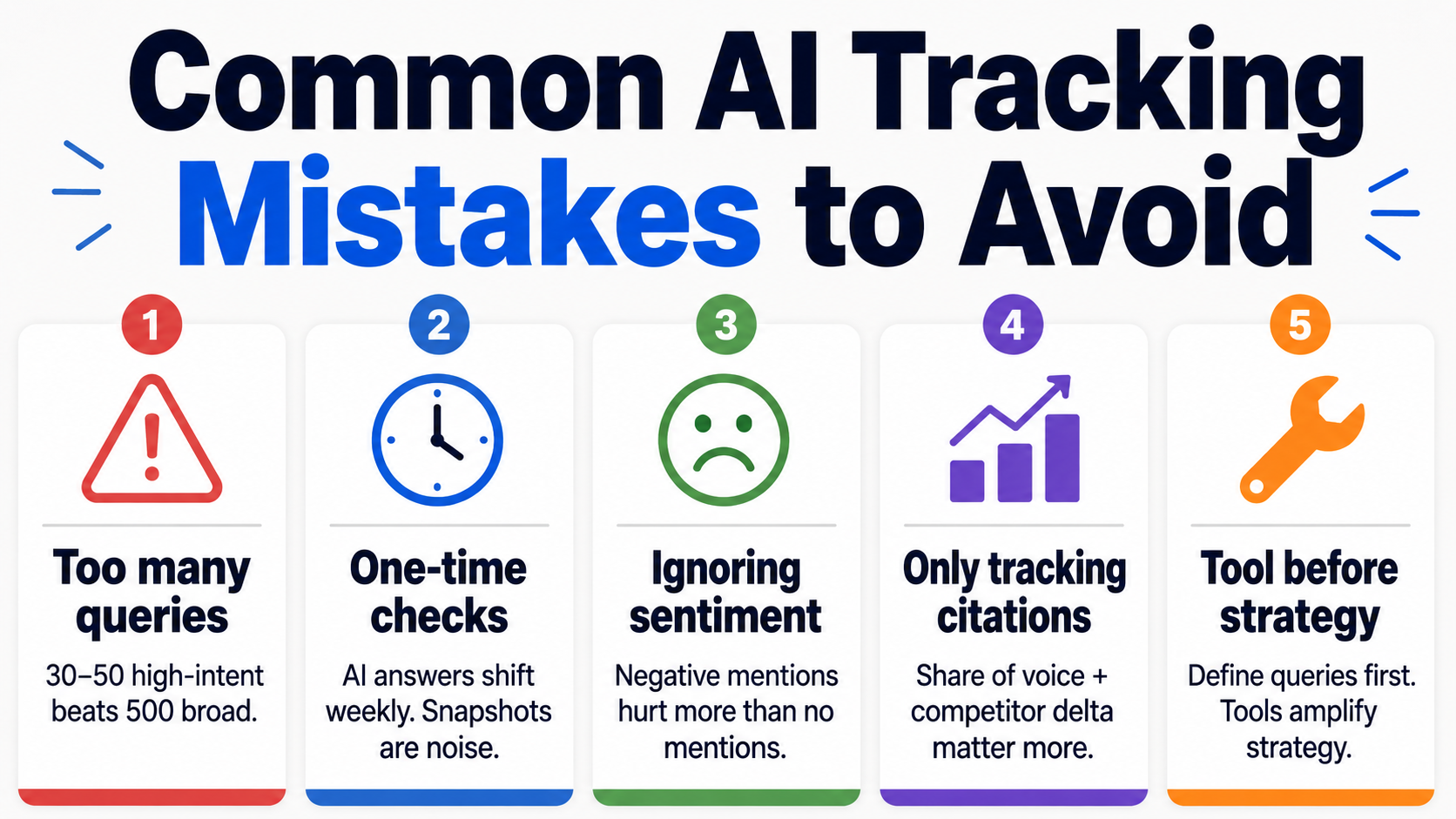
- Tracking too many queries. 30 to 50 high-intent queries beat 500 broad ones. Focus on the ones that drive revenue.
- Running queries once. AI answers shift week to week. Single snapshots are noise.
- Ignoring sentiment. A negative mention is worse than no mention. Treat context as a first-class metric.
- Stopping at “did I get cited.” Citation rate is the start. Share of voice and competitor delta are where strategy lives.
- Buying a tool before defining your queries. Tools amplify a clear measurement strategy. They do not create one.
Frequently asked questions about AI search tracking
Can I track AI search visibility for free?
Yes. Manual prompt sampling, Google Search Console AI Overview data, brand alerts, and analytics referrer filtering give you a workable picture at zero cost. Paid tools save time and scale the sampling, but they are not required to start.
How often should I check AI search rankings?
Weekly for your priority query set, monthly for full trend reviews. AI answers shift more than classic search results, so daily checks add noise more than signal. Weekly cadence catches real movement without burning your team’s time.
Which AI engine should I prioritize tracking?
Start with whichever engine your buyers actually use. For most B2C local businesses in 2026, that is Google AI Overviews. For B2B and tech buyers, ChatGPT and Perplexity carry more weight. Check your analytics referrers to see where actual traffic is already coming from, then track the engines sending it.
Are AI rank trackers accurate?
Reasonably, with caveats. Because AI answers are non-deterministic, every tracker uses sampling. Two tools may report slightly different citation rates for the same query. Pick one tool, stick with it for consistency, and treat the trend as the signal rather than the absolute number.
Does tracking AI visibility change my SEO strategy?
It should. If you find competitors winning citations on your money queries, that points directly at content gaps, missing schema, or thin authority signals. The data feeds back into your AI SEO program, and the gap analysis usually reveals more practical work than a traditional audit does.
Get help building your AI tracking stack
Measurement is the difference between a GEO strategy that compounds and one that drifts. If you want a partner who builds the tracking workflow alongside the content, schema, and citation work, that is exactly what our SEO for AI service covers. For the broader foundation, our SEO services handle the technical and content work that AI tracking depends on. Contact us for a tracking setup quote.