

 (647) 478-5858
 (728) 500-4818
Someone in their kitchen asks, “Hey Siri, who’s the best plumber near me?” Their hands are wet. They are not going to scroll a results page. Siri picks one business and reads the answer out loud. That one business wins the lead. Everyone else is invisible.
Voice search has changed quietly in 2026. The old playbook (long-tail keywords, FAQ pages, schema) still matters, but AI assistants like ChatGPT Voice, Gemini Voice, Apple Intelligence, and Alexa+ now read entire generated answers, not just snippets. Winning voice queries means winning AI citations, not just rankings. This guide breaks down what changed, what still works, and the 2026 playbook for getting your business picked.
What changed in voice search between 2020 and 2026
Old voice search was Google reading a featured snippet aloud. New voice search is an AI assistant generating an answer from multiple sources and naming one business as the recommendation. The shift is from “fetch and read” to “synthesize and recommend.”
- Assistants got smarter. Siri now has Apple Intelligence and uses ChatGPT for complex queries. Alexa+ added generative AI in 2025. Google Gemini Voice replaced classic Assistant on most Android devices.
- Answers got longer. A voice answer in 2020 was a 25-word featured snippet. In 2026 it can be a 60-word synthesized recommendation with a single named business.
- Citations got picky. AI voice assistants are more selective about which sources they trust. Schema, entity signals, and review quality matter more than raw page authority.
- Local intent exploded. “Near me” queries are now 70+ percent of voice searches on mobile. AI assistants pull from Google Business Profile, Apple Business Connect, and review platforms more than from your homepage.
The old fundamentals still apply, but if you stop there, you lose. This is one of the surfaces our AI SEO program covers end-to-end alongside schema and citation tracking.
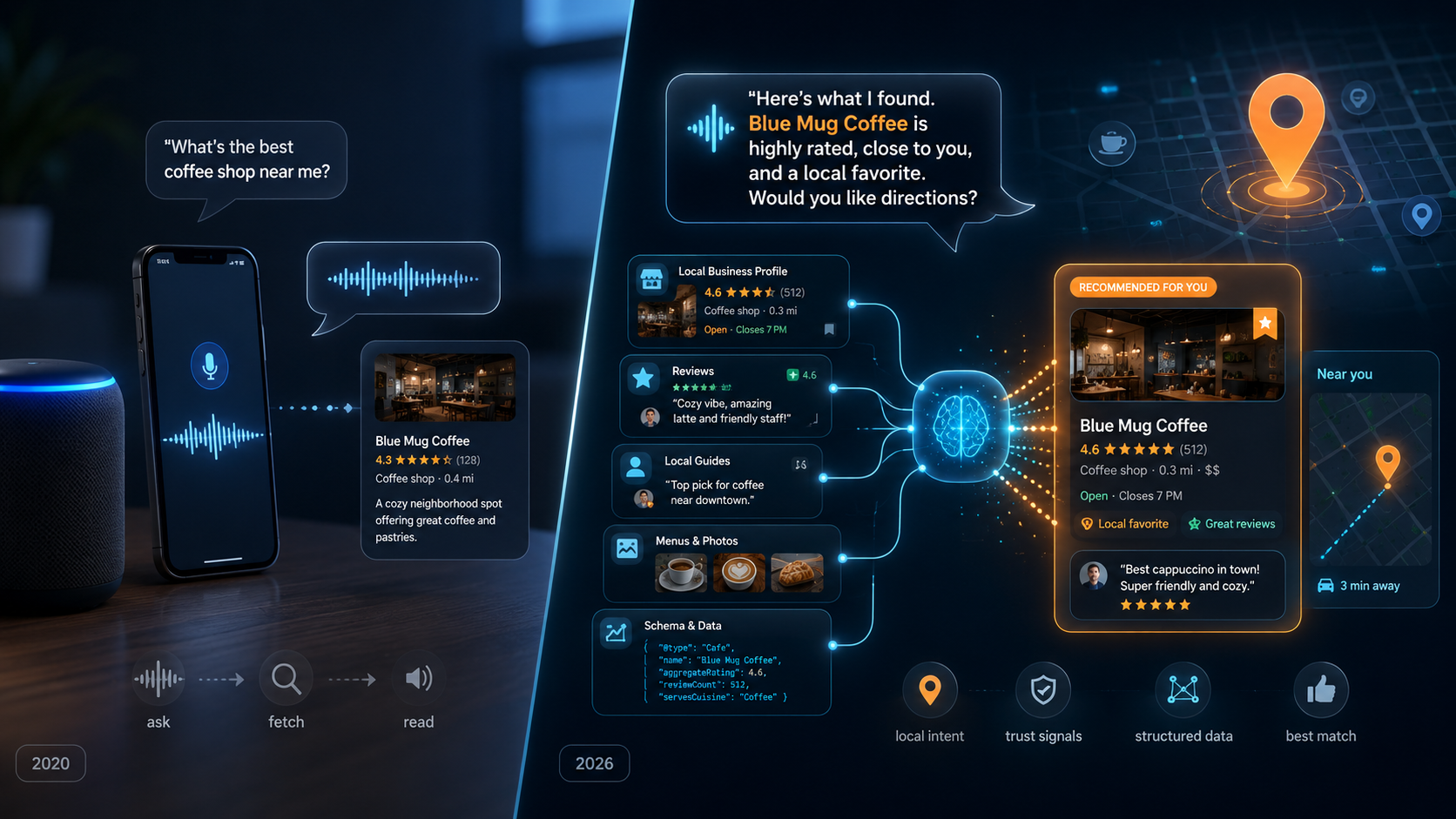
How AI voice assistants actually pick which business to recommend
Each assistant has its own logic, but the inputs overlap heavily. The shortlist:
- Entity confidence. Is this a real, identifiable business with consistent NAP across the web?
- Schema clarity. Does the site expose LocalBusiness, Organization, FAQ, and Speakable schema cleanly?
- Review signal. Volume, recency, and average rating across Google, Apple Maps, Yelp, and industry directories.
- Conversational match. Does the content answer the question in the same words a person would speak?
- Source diversity. Has the brand been mentioned in news, blogs, or other AI-trusted sources, or only on its own website?
- Proximity and hours. For local queries, is the business open now and within the user’s area?
None of these are new individually. What is new is that AI assistants now weight them as a stack, not a checklist. Miss any one badly and the assistant picks someone else.
The 2026 voice search optimization playbook
1. Write the way people speak
Voice queries are full sentences, not keywords. “Best HVAC repair near me open Sunday” is the actual query, not “HVAC Sunday.” Build pages and FAQs that mirror conversational phrasing. Lead each section with the spoken question as the heading, then answer in 40 to 60 words. That length matches what voice assistants read aloud.
2. Lock down LocalBusiness schema
Voice search is local search 70+ percent of the time. LocalBusiness schema with full PostalAddress, geo coordinates, openingHoursSpecification, and areaServed gives the AI everything it needs to qualify your business for proximity-based voice queries. Pair with FAQ schema and Organization schema. For the full schema map, see our schema markup for AI search guide.
3. Add Speakable schema where it counts
Speakable schema marks the parts of your page that voice assistants should read aloud. Most sites have not added it yet, which is exactly why doing so now creates a measurable edge. Mark the one-sentence direct answer under each FAQ heading. Keep it tight: voice assistants will not read paragraphs they cannot finish in 15 seconds.
4. Optimize your Google Business Profile and Apple Business Connect
AI voice assistants pull from these profiles before they pull from your website for local queries. Categories, hours, attributes, and review responses are all signals. Apple Business Connect (Apple Maps) is increasingly important because Siri and Apple Intelligence default to it. Our Google Business Profile optimization service handles the GBP half; Apple Business Connect needs equal attention.
5. Build review velocity with real customers
Review signal is now a top three voice citation factor. Aim for steady review velocity (a few new reviews every week beats 100 reviews from 2022). Respond to every review with a short, professional reply. AI assistants read the responses too, and consistent professional replies signal an active, accountable business.
6. Win the featured snippet for spoken queries
Many AI voice answers still pull from Google’s featured snippet for non-local queries. The structure that wins snippets is the same structure that wins voice: a clear question heading, a 40 to 60 word direct answer right under it, then supporting detail below. Use this format on every FAQ and pillar page.
7. Be discoverable by AI crawlers
Check your robots.txt. GPTBot, ClaudeBot, PerplexityBot, Google-Extended, and Applebot-Extended need to be allowed if you want those engines to crawl and cite your content. Blocking them by default is a common SEO mistake that quietly removes you from AI surfaces. Allow the ones whose engines you care about. Block only the ones you explicitly do not want.

How to test if your site is voice-ready
Run a 10-query voice audit this week:
- Pick 10 priority customer questions, phrased the way someone would speak them.
- Ask each question to Siri, Alexa+, Google Gemini Voice, and ChatGPT Voice.
- Record whether your business is named, mentioned alongside competitors, or absent.
- Note the exact wording the assistant uses, especially for negative or neutral framing.
- Compare to the result you would see in a Google search for the same query.
That 30-minute exercise reveals more about your voice visibility than any tool. Repeat monthly and track the trend. For a deeper tracking setup with the right paid tools, see our AI search visibility tracking guide.
Common voice search mistakes to avoid
- Optimizing for typed keywords only. Voice queries are longer and conversational. “Plumber Toronto” rarely matches what a real voice user says.
- Burying the answer. Voice assistants will not read your intro. Lead with the direct answer.
- Forgetting Apple Business Connect. Siri uses it. If your profile is thin, Siri picks a competitor.
- Ignoring review quality and recency. A 4.9-star average from 2021 with no recent reviews loses to a 4.6-star with reviews from last week.
- Blocking AI crawlers in robots.txt by default. Some SEO plugins added blocks without flagging them. Audit your file.
Frequently asked questions about voice search optimization
Is voice search still a thing in 2026?
Yes, and more than ever. The rise of AI assistants (ChatGPT Voice, Gemini Voice, Apple Intelligence, Alexa+) has pulled voice queries above 30 percent of mobile search volume in many categories. The shape changed: assistants now generate answers instead of reading snippets, but the user behavior is bigger than ever.
What is the most important factor for voice search SEO?
For local businesses, it is the combination of a fully optimized Google Business Profile, LocalBusiness schema, and recent positive reviews. For non-local queries, it is winning the featured snippet by leading with a clear 40 to 60 word direct answer under a question-format heading.
Does FAQ schema help with voice search?
Yes. FAQ schema gives voice assistants a labeled question and a clean answer they can read aloud. Pages with FAQ schema get cited in voice answers measurably more often than equivalent pages without it.
How long should a voice search answer be?
40 to 60 words is the sweet spot. Long enough to fully answer the question, short enough for an assistant to read in one breath without sounding robotic.
Should I optimize differently for Siri versus Google Assistant?
Cover the fundamentals once and you cover most engines. Siri pulls from Apple Maps and ChatGPT, so prioritize Apple Business Connect plus AI SEO basics. Google Gemini pulls from Google Business Profile and Google Search, so prioritize GBP and traditional SEO. Same schema, content, and review work serves both.
Get your site voice-ready
Voice search optimization is one piece of a bigger AI search strategy. If you are running through the GEO playbook and want voice baked in from day one, that is exactly how our SEO for AI service is structured. For the broader foundation, our SEO services handle the technical work that voice search depends on. Contact us for a voice audit and quote.